
The Manway That Was Never Pressure Tested
Shortly after midnight on April 8, 2021, an operator at a resin plant in Columbus, Ohio, restarted the agitator on a production kettle. It had stopped earlier, likely because of electrical work nearby. Hot resin and flammable solvent vapor escaped from the top of the kettle and spread through the building. At 12:04 a.m. the vapor cloud ignited.
One employee died from burns and smoke inhalation. Eight others went to hospital with injuries that included third-degree burns and fractures, and one lost a leg after being crushed under collapsed debris. The explosion shook neighboring buildings.
The facility was the Yenkin-Majestic paint and OPC Polymers complex. In September 2026 the company pleaded guilty in federal court in the Southern District of Ohio to a charge of negligent endangerment. On October 19, 2026, the U.S. Chemical Safety Board announced that the company had implemented none of the five safety recommendations the Board made to it in 2023 and had not answered three letters about them.
A change that skipped its test
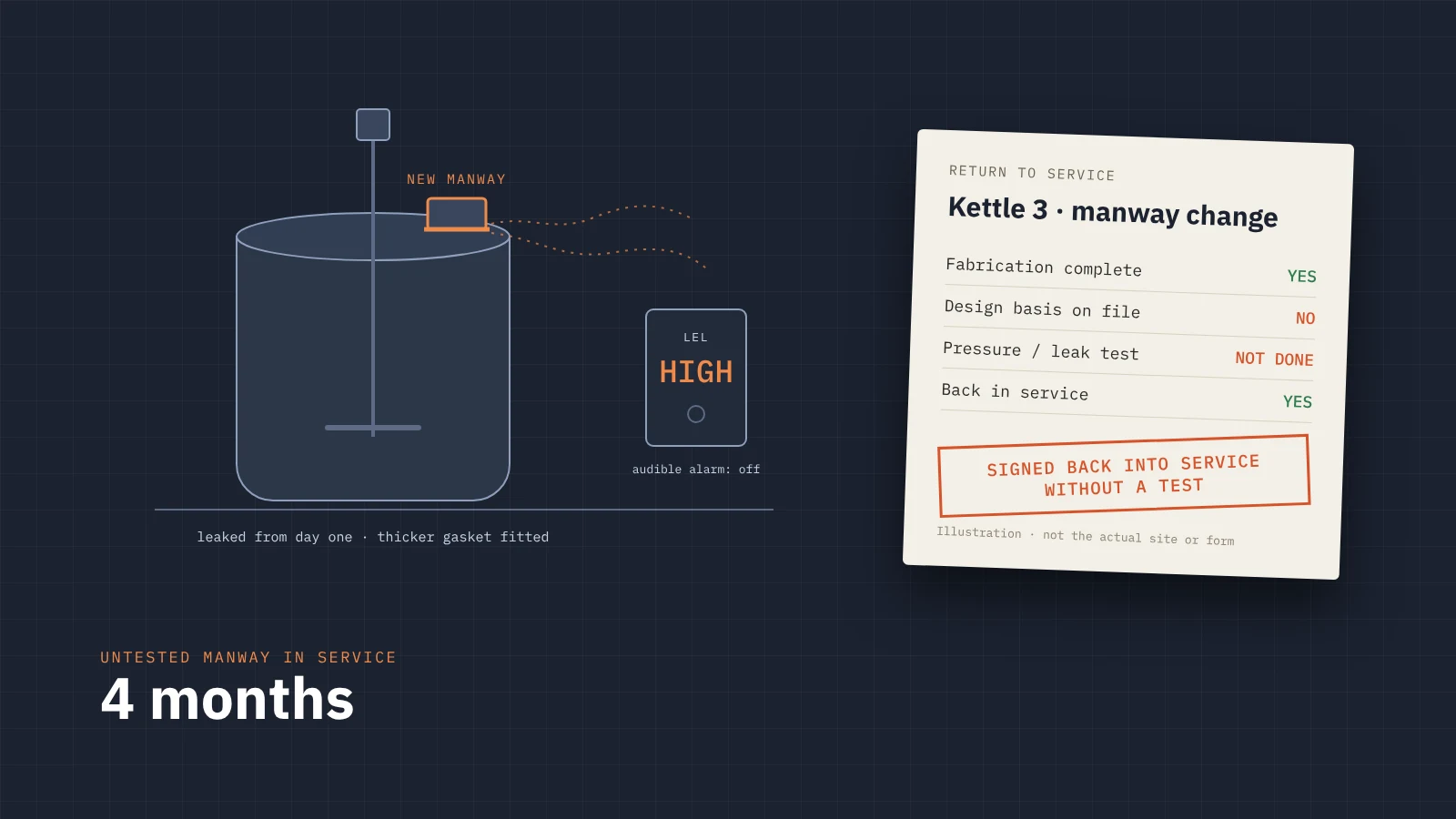
According to the Department of Justice, the company installed a new manway on top of Kettle 3 in December 2020 with help from a local fabrication company. It was never pressure tested before the kettle went back into service.
The manway leaked as soon as it was installed. The kettle stayed in use. The fix was a thicker gasket, which the company believed was Teflon. It was silicone.
The CSB's final report, released in November 2023, found that the manway cover had not been properly designed, built or tested, and that the company did not follow basic quality assurance practices for pressure vessel integrity. The kettle held naphtha solvent. When the seal gave way, pressurized vapor and resin came out through it.
The plant had flammable gas detectors. The DOJ account says they were not configured to sound an audible alarm. The CSB found no audible or visual alarm to warn employees to leave. It also found the emergency plan and training inadequate, and flame-resistant clothing was not required in the area.
Reading it as an investigator
The restart was the trigger. A report that stops there would describe the last few minutes and miss the four months before them.
We would grade the barriers one at a time.
Management of change was absent. Replacing a manway on a vessel in flammable service is a change to the pressure boundary. A working change process would have asked for a design basis and a pressure or leak test, and would not have signed the kettle back into service without both. The record shows neither happened.
The leak was a warning, and it was treated as maintenance. A new component that leaks on day one is telling you something about its design or fit. Swapping in a thicker gasket kept production running and left the question unanswered. The wrong gasket material then went into the joint without anyone catching it, which points to a gap in how parts were specified and checked.
Detection was partial. The detectors existed and could sense the vapor. Nobody had configured them to tell people to leave. A detector that warns nobody gives no protection to the people standing beside the kettle.
Mitigation was weak. The CSB's findings on emergency planning and protective clothing describe what happened after the release started. Those shaped how many people were hurt and how badly.
Low-pressure vessels sat in a gap in the standards. The CSB also recommended that the American Petroleum Institute and ASME write design and alteration guidance for low-pressure process vessels in flammable service, up to 15 psig. Plants that treat these vessels as outside their pressure equipment program are relying on judgment where a standard would help.
Five recommendations, still open
The CSB does not fine anyone. It investigates and recommends. To this company it made five recommendations:
- Update mechanical integrity procedures for every process vessel in highly hazardous chemical service to adopt alteration guidance from API 510 or the National Board Inspection Code.
- Document the design, construction and alteration standards for pressure vessels in new resin plant designs, reassess them at least every five years and keep the inspection, alteration and repair records.
- Use prevention through design and the hierarchy of controls in future resin plant designs, with inherently safer design first.
- Identify equipment that could release flammable material, fit lower explosive limit detectors with visual and audible alarms, and train people to evacuate when they sound.
- Require flame-resistant clothing in operating areas that handle flammable chemicals, and train on it.
The CSB sent them to the company's chief executive in December 2023. It wrote again in February 2026 and in September 2026. All five are listed as "Open, Unacceptable Response/No Response." The Board's executive director of investigations said the silence seems to show "a serious disregard for the safety of the company's workers."
Most plants will never receive a letter from the CSB. Recommendations still arrive from insurers, auditors, corporate engineering, regulators and their own investigations. Each one needs a written response that records the decision and the role that owns it. It stays open until there is evidence it is done. A recommendation that sits unanswered for three years has been rejected by default, and nobody signed that decision.
Where Intero fits
Intero investigates incidents like this one and finds the root cause. An investigator describes what happened and adds the photos and documents they have. Intero asks the follow-up questions a lead investigator would, one at a time, including what changed on the equipment and what should have stopped the release.
In the analysis, each barrier is graded held, failed, partial, absent or unknown, and contributing factors are traced from the task through to the organization and the applicable standards. Every finding cites the evidence it rests on. If the management of change procedure is in the organization's library, Intero reads it with the case.
Corrective actions are written up the hierarchy of controls, each traced to a finding, with an owner role, a horizon, the evidence that will close it and a measure of its effect. Actions go live in the CAPA tracker. When one is finished, its owner is asked by its horizon whether the fix held, and Intero looks through later cases for the same failure coming back.
You can see how a case runs in Intero and what the workspace includes.
A check worth doing this week
Pull the last twelve months of changes to vessels and piping in flammable or toxic service. For each one, find the record of a pressure or leak test before it went back into service. Then walk your fixed gas detectors and write down what each one actually does when it reaches its alarm point.
If you want to see how Intero takes an incident from the first report to a fix that holds, book a demo.
---
Sources
- U.S. Chemical Safety and Hazard Investigation Board, Yenkin-Majestic OPC Polymers Fails to Implement the U.S. Chemical Safety Board Recommendations to Improve Safety at Columbus, Ohio Facility Where Deadly Explosion Occurred, October 19, 2026.
- U.S. Chemical Safety and Hazard Investigation Board, Yenkin-Majestic Resin Plant Vapor Cloud Explosion and Fire (investigation page, final report and recommendation status).
- U.S. Department of Justice, Ohio company pleads guilty in worker death case, September 4, 2026.